Yuguang Shi
Game Designer
AceForce2: AI Pre-aim System
Platform:
Mobile
Tools Used:
Unreal Engine, Lua
Overview
In NF, a competitive FPS inspired by classic Counter-Strike–style bomb-defusal gameplay, AI behavior is designed with a strong focus on human-like combat decision making.
Because the game features an extremely low time-to-kill (TTK), accurate crosshair placement and pre-aiming at head level are critical skills for players. To achieve believable AI performance in this environment, the AI system must simulate how experienced players clear angles, hold positions, and react to threats.
The goal of this AI design is therefore not only to enable functional combat behavior, but to replicate player-like tactical habits, such as pre-aiming common angles, prioritizing high-probability threat positions, and maintaining consistent aiming behavior while moving or holding positions.To achieve this, the system focuses on improving:
-
Pre-aim angle selection
-
Angle clearing logic
-
Movement and aiming coordination
-
EQS-based position evaluation
These improvements allow the AI to behave more naturally during combat, reducing robotic behaviors such as abrupt angle switching, unrealistic movement patterns, or holding angles without clear tactical reasoning.
AI Behavior Issues Analysis
During early testing of the AI aiming and positioning system, several behaviors were identified that broke the intended human-like combat simulation. These issues mainly occurred during angle searching and target loss scenarios.
Observed Problems
The following behaviors were observed in the current AI system:
-
AI sometimes moves backward while aiming, creating unnatural movement patterns.
-
EQS-generated positions can be too extreme, occasionally selecting unrealistic or tactically meaningless locations.
-
AI switches angles too frequently, causing unstable aiming behavior.
-
AI may hold a single angle for too long, resulting in passive or unrealistic behavior.
Root Causes
Further investigation revealed several underlying design problems in the system.
Lack of a Fallback Solution
The system lacks a fallback mechanism when no valid search point is available.
As a result, when the AI fails to find a suitable point:
-
The AI loses its target
-
The AI defaults to aiming toward the spawn location, which breaks immersion and tactical logic.
Previously Checked Angles Are Not Filtered
The system does not properly track previously checked angles.
This causes the AI to repeatedly search the same positions, leading to inefficient and unrealistic angle clearing behavior.
EQS Position Generation Is Too Generic
The EQS generator does not consider regional gameplay context.
As a result, some generated positions are located in places where players would rarely stand, such as awkward corners or tactically meaningless spots.
Angle Scoring Is Too Loose
The current angle evaluation scoring is overly permissive.
This causes the AI to treat too many angles as valid candidates, which leads to:
-
Excessive angle switching
-
Lack of stable aiming behavior
Design Direction
To resolve these issues, the following improvements were introduced:
-
Introduce a fallback holding-angle solution when no valid point is found
-
Filter previously checked angles through a scoring system
-
Adjust EQS generators based on level regions
-
Tighten the angle evaluation scoring rules
These changes allow the AI to produce more stable, tactical, and believable angle-clearing behavior.
Optimization Solution
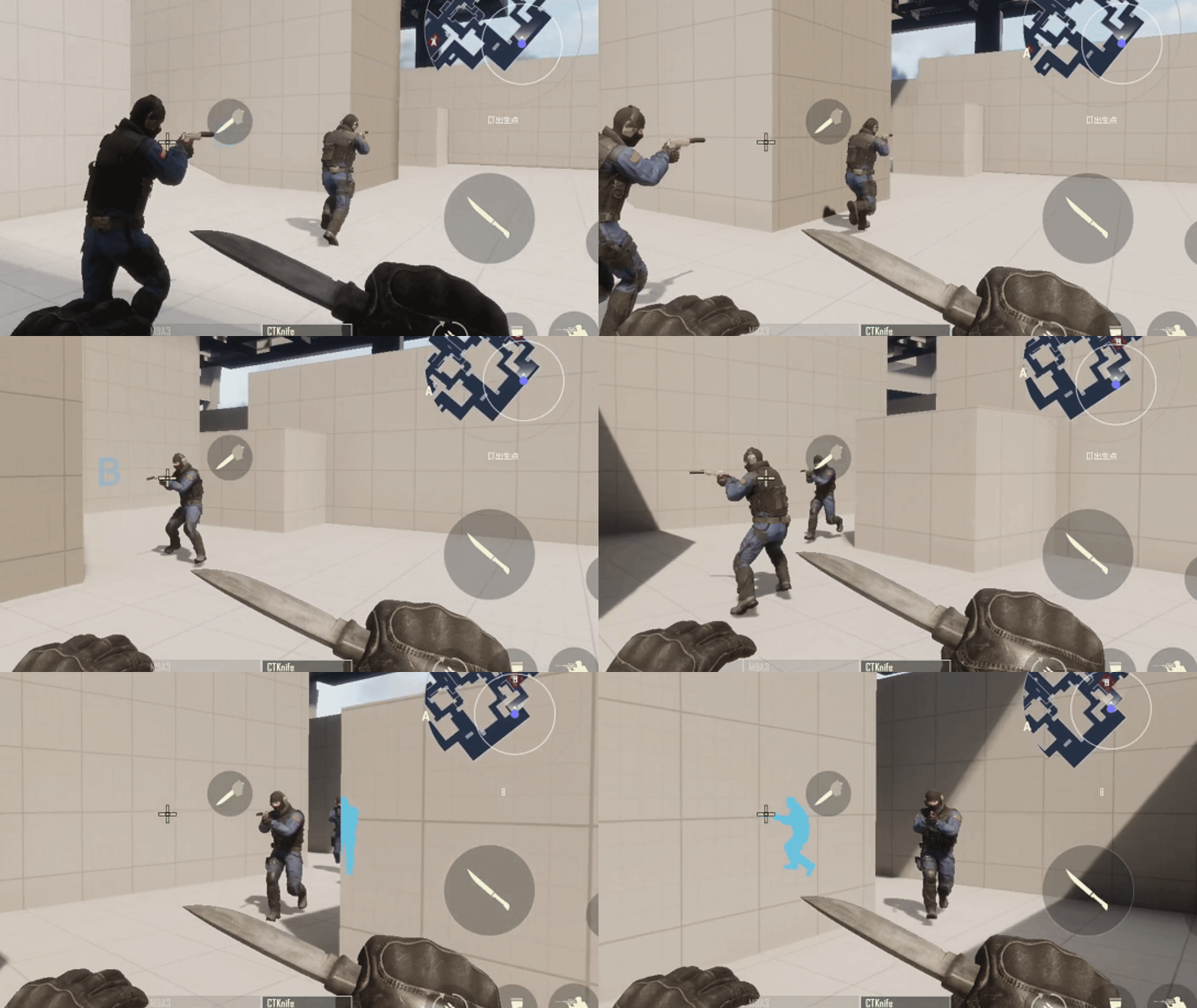
To improve the AI’s angle-clearing behavior and prevent repetitive scanning, a pre-aim scoring system was introduced to manage how AI selects and revisits aiming points.
Pre-Aim Scoring Mechanism
-
Each pre-aim point is assigned a dynamic score.
-
When the AI checks a point during its search sequence, the score of that point increases.
-
Points with high scores are temporarily filtered from the candidate pool, preventing the AI from repeatedly checking the same location.
-
Scores gradually decay over time, allowing previously checked points to become valid search targets again.
Angle-Based Detection
To determine whether a point has been checked:
-
If the angle between the AI’s facing direction and the pre-aim point is less than 45°, the system considers the point searched.
-
Once marked as searched, the point’s score increases and is temporarily deprioritized.
Design Outcome
This system creates a more natural angle-clearing behavior similar to how experienced players check corners:
-
Prevents repeated scanning of the same angles
-
Encourages the AI to search new directions before revisiting previous ones
-
Maintains dynamic angle coverage through score decay over time
Result